Sound Absorption / Diffusion
We have two major choices to make regarding the management of sound energy within our home theater, personal listening, and professional control rooms. We can absorb or diffuse sound energy in order to manage it correctly. We can use absorption to manage low, middle, and high frequencies. We can use diffusion to manage middle and high frequencies. It is a blend and combination of these two technologies that go into each of our sound rooms.
Acoustic Products Expensive
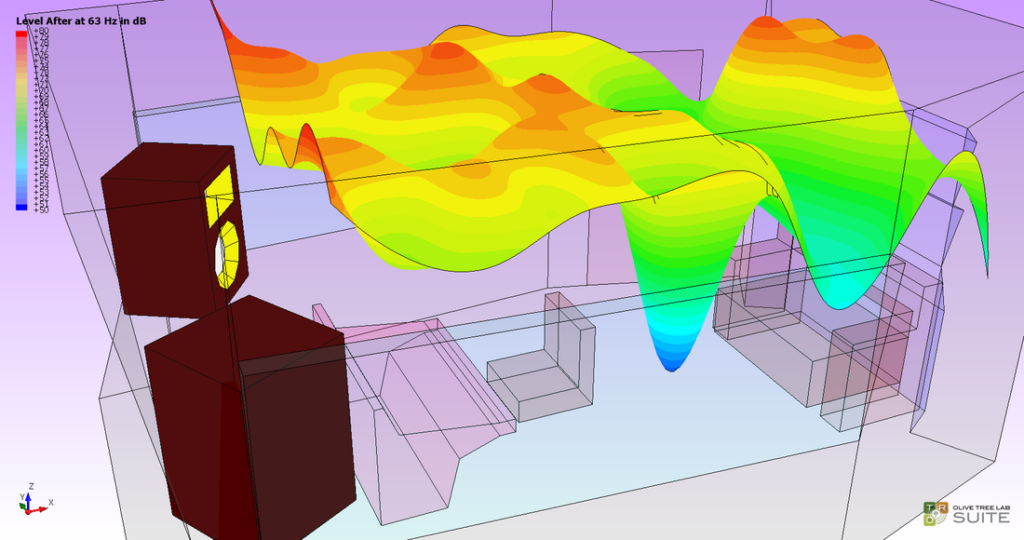
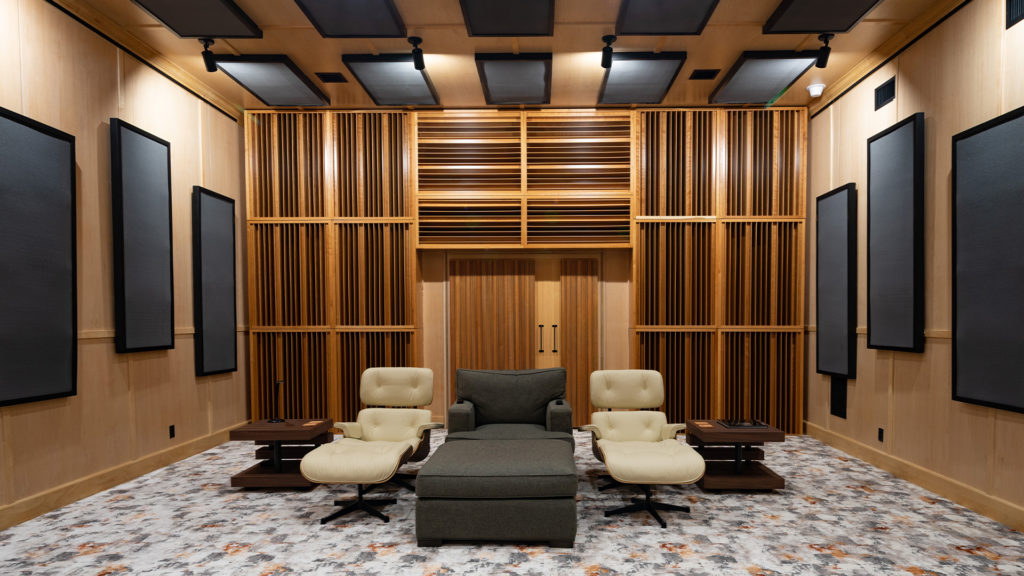
Quality room acoustic products are expensive. You also need numerous units to treat the surfaces of the any room. To have any sonic impact from room acoustic treatment, at least 25% of the surface area must be treated. In a control room, we have the rear wall which normally would be treated with diffusion. Both side walls must be splayed or angled to minimize side wall reflections. The surface area of each side wall is treated with absorption. Low frequency management is essential in any room whether a listening room, home theater room, or professional recording studio. With today’s smaller rooms, low frequency control must include numerous units.
Wood Shop
If you have access to a small wood shop with a saw, it can be table or hand held, and you have some wood working skills, you can build your own professional low frequency absorbing units along with middle and high frequency absorption and diffusion. There are no angles to cut, everything is a straight line. Build drawings are provided with assembly instructions and an actual step by step build with photos. A tool list, cut sheet, and material complete everything you need to build your own units.
Low Frequency Absorption Units
There are many types of sound absorption devices available that claim to be bass traps or low frequency absorbing devices. There is the standard box filled with building insulation. Foam wedges are another popular unit that is claimed to absorb low frequencies. None of these units are really low frequency absorbing devices. John Storyk, the principle of Walters Stork Design Group, did a test on all of these devices in 2006 and published his results in an AES paper. His conclusion was that of the eight units he tested, only one actually did work as claimed. It was a membrane absorber with the most dense front panel or another term could be diaphragmatic absorber.
Diaphragmatic Absorber
A diaphragmatic absorber is a cabinet that has a front wall that moves or vibrates in sympathy with the amount of sound pressure that is exerted upon it. The cabinet is more rigid than the front wall and is designed this way on purpose. The depth of the cabinet and the density of the materials used are critical in determining the frequency of resonance of that cabinet. One can design a diaphragmatic absorber to absorb any low frequency issues within a room. Foam wedges and boxes filled with building insulation can not.
Cabinet Fill Material
Inside the cabinet, there is an internal cabinet fill, usually some type of building insulation material. One can take the internal fill material and expand upon it to increase its efficiency. The internal cabinet fill material must absorb internal cabinet resonances and also contribute to the cabinet’s overall performance. It is by far the only low frequency absorber that has the horsepower to actually tackle the energy generated from low frequency wavelengths. Diaphragmatic absorption is used extensively by the top room designers when they are designing and building multi- million dollar rooms.
BDA – Broadband Diaphragmatic Absorber -DIY
The BDA unit that we are offering is unique in many ways. First, the cabinet design is a tested unit that has undergone vibrational testing in our facility. It is designed to be as inert as possible using only one layer of material. At 4.4 lbs./ sq. ft. it is a heavy unit but mass is necessary if you are going to attempt to stop low frequency energy. The front wall has also been calculated to work with the chosen cabinet density and comes in at 2.4 lbs. / sq. ft.
Perforated Absorber Cabinet Fill
The internal cabinet fill is not just material inserted into the cabinet. The internal fill material is actually another unit itself. It is called a perforated absorber and is designed to absorb at a frequency that will minimize internal cabinet resonances and then compliment the total cabinet design to achieve absorption down into the 40 cycle range. A perforated absorber is a separate unit that has a front wall that has perforations of a certain diameter and certain number to produce a unit that has a specific resonant frequency.
FB – Foam Box – DIY
The FB or foam box unit is a cabinet that is designed to hold any type of acoustic foam that one desires. There are numerous open celled acoustic foams that are available in the marketplace and our foam box is a unit that one can build that can be finished to match any decor. The fabric face and frame assembly is the same process that we have used in our production units and we have many units that are now over six years old and holding up well. If the fabric is damaged, the face frame can be removed and a new piece put into its place.
QRD-11 Quadratic Residue Diffusor – DIY
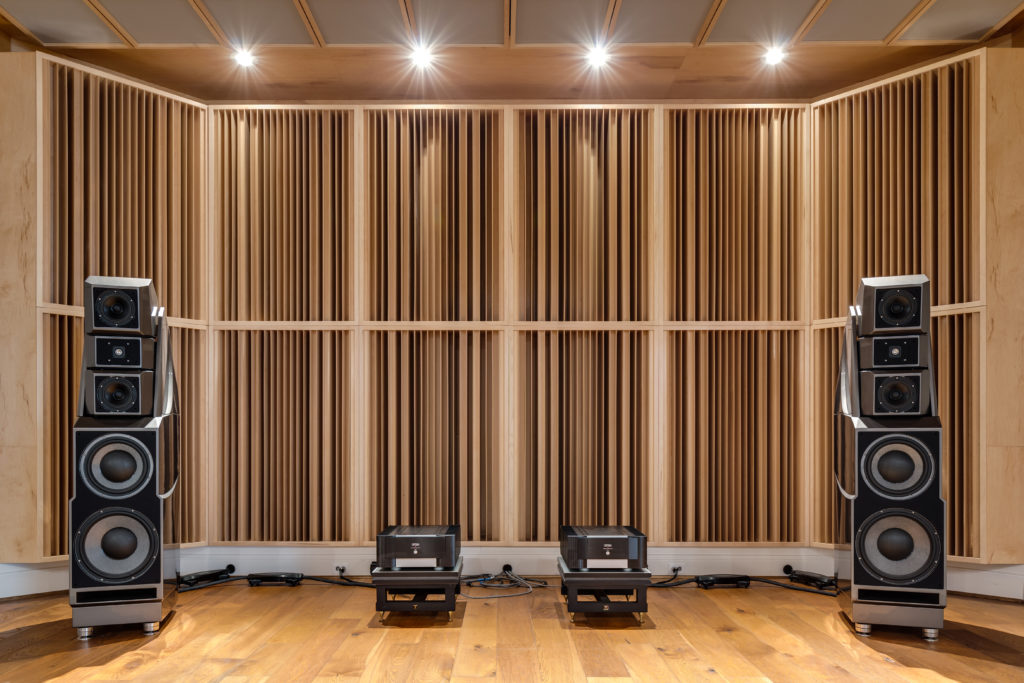
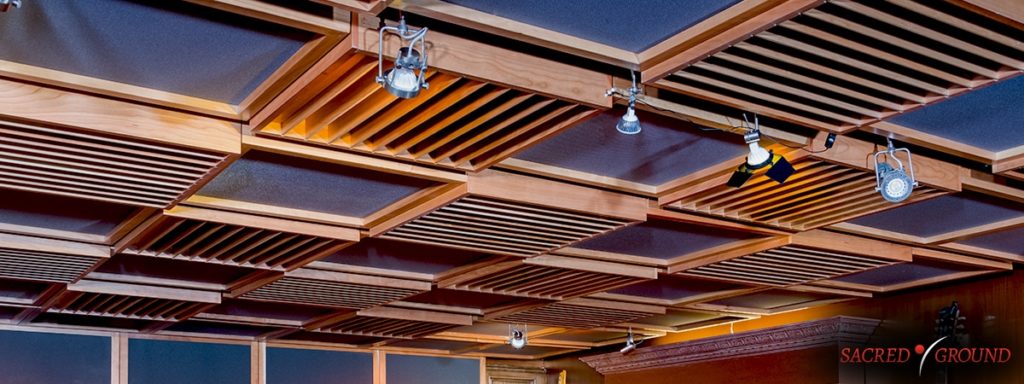
The QDR-11 is an actual quadratic diffusor based on prime number 11. Each well depth and width has been calculated to produce a diffusion frequency range from 300 Hz.- 3,ooo Hz. Quadratic diffusion has been time tested and proven throughout the years and is used extensively by professional studio designers. Quadratic diffusors can be used to produce two dimensions of sound diffusion. A vertically positioned quadratic diffusor will diffuse energy in a horizontal dimension. A horizontally positioned diffusor will distribute sound energy in a vertical array.
Low, Middle, High Sound Management
We need to have low, middle, and high frequency sound energy control in our home theater, listening rooms, and professional recording studios. To accomplish this, we need to use sound absorption and sound diffusion technologies. Unfortunately, room acoustic technologies that really work well are expensive and you need numerous units to meet your acoustic objectives. With DIY units that one can build themselves, the costs of treating your rooms can be minimized without sacrificing room sonic integrity.


Recent Comments