The Mechanics Of Soundproofing – Part I

Sound And Vibration

All sound is created by vibrations. Sound vibrations must have a medium to travel in. The most popular and familiar medium is air and we hear those sound vibrations everyday through air. Air does a reasonable job of transmitting sound vibrations because it has low mass and can transmit sound energy over a wide band of frequencies.

Air Travel

Air is a good medium for low frequencies but less effective at higher frequencies. When you are farther away from a loudspeaker, you will notice that the high frequencies are less pronounced or in audio jargon, rolled off. If you go to a live performance and you do not like piercing highs coming at you at large pressure levels, sit farther back. If you are trying to get the attention of your friends to help direct them to your seating area and you call out their names from far away, the same muffled high frequency effect occurs.

Concrete Barrier

Concrete Barrier

Room Mass

Your room whether it is a listening room, home theater room, or professional recording studio will have objects within it that have much more mass than air does. This increased mass of these objects will be less effective at transmitting shorter wavelengths namely high frequency energy. When you hear the stereo or band playing in the next room or adjoining structure, one usually “hears” the lower frequencies because they are transmitted through the structure more easily than higher frequencies. With these examples in mind, lets formulate a few guidelines:

1. Soundproofing is really about lower frequencies.
2. All sound that is transmitted needs a medium to move through and that medium must be continuous.
3. In our audio rooms the medium will be a solid structure with mass such as drywall, wood, or concrete.

Sound Pathways

Lets look at a sound wave as it leaves our neighbor’s stereo system. When the frequencies strike our wall surface, some of the energy is reflected back to the source and some of the energy goes through the wall itself. This is the point where people usually get confused about sound treatment and sound proofing. If we are trying to keep the sound energy within the room, then the room’s reverberation times will increase and we need to use acoustical treatment within the room. The sound energy that escapes our room, will not add to our room’s reverberation signature, but will annoy all individuals in adjacent structures. This is where soundproofing comes in.

Hard Surfaces

The hard surface of our walls is a partial explanation for this phenomenon. It is the hardness of the wall’s surface, but the composition of the wall itself. The wall has increased mass over air and this increased mass is like your car hitting a brick wall abruptly. The air is what we term to be compliant and the wall is much less compliant. This wide level of density changes from air to a solid wall changes the transfer of energy ratio. Thus, only a fraction of the energy that was in the air to start with will penetrate the wall itself. This is why our homes are quieter when all the doors and windows are closed.

Poured Concrete Barrier

Poured Concrete Barrier

Energy Not Lost

The energy that does not penetrate our walls must also be looked at and examined. We know from the laws of physics that the energy can not simply vanish. This comes from the First Law of Thermodynamics which states that energy is neither created or destroyed. Since there is nothing to absorb the energy, it will only be reflected back. If we place what the literature calls “acoustic tile” on the wall, we now have a situation that the tile is denser than the air but obviously not as dense as dry wall. This offers us a change in density. Tracing the sound transmission path, we have air to tile and tile to wall. Therefore, less energy will reflect back and some of our higher frequency, air borne, energy will be absorbed. However, more of our lower frequency energy will be transmitted. How do we reduce these transmissions?

Abrupt Mass Change

We know that we need an abrupt change in mass to have an impact on our vibration transmissions and thus sound energy. Lets examine two different structures to illustrate our points. If we take a wall that has two sheets of drywall glued together and nothing in between and a wall with the same two sheets of drywall separated by studs, we have two walls that have the same mass, but the wall separated by the studs will have a higher sound transmission class number holding back more sound energy. The wall with the studs contains more changes in mass or density for our vibrations to travel through.

Common Drywall

In our two pieces of drywall only example, sound energy strikes our wall and then travels quickly through both walls. In our wall with the studs separating the two pieces of drywall, we have an air space between the two pieces of drywall. Incidentally, we can make that structure even more effective by filling the air cavity between the drywall panels with a fibrous material such as mineral wool or fiberglass insulation. That’s because the cavity between the drywall sheets will resonate, and friction of the vibrating air against the fibers will produce heat. We can’t actually destroy the energy, but we can turn it into non-acoustic form.

Lower Frequencies

Either wall structure will work well when we consider lower frequencies. In both of our wall examples, the drywall will have to be nailed to studs for support. It would be great if we could figure out how to have them “float” in space without any attachment points but that is not realistic. The drywall sheets nailed to the studs, will form a solid entity which is a road for lower frequency energy to travel upon. Even though the two walls are different because of the air space, they are both viewed as a solid entity by longer, lower frequency energy.

Sound Mediums

Sound travels through mediums. Air is a medium and so are the physical materials we use to build our home theater, personal listening rooms, and professional recording studios. To soundproof our structures we must use mass that is arranged in a specific manner in order to reduce vibrations. It is the vibrations that produce sound energy and proper structure vibrational management is critical if we are to have any success at the soundproofing task. In part two, we will discuss more on vibration and damping.

Sound Proofing Vs. Sound Treatment

Sound Treatment Vs. Sound Proofing

Sound treatment and soundproofing are terms that have completely different meanings. Both terms share some of the same physics to arrive at their meaning, but both have completely different acoustical objectives. However, I can tell from the questions that I receive from customers, that the meaning of sound treatment is mistaken for sound proofing and the definition of soundproofing is used when we are really discussing sound treatment. Lets look at both closely, so we can see the differences more easily.

Concrete Barrier

Concrete Barrier

Sound Isolation

Sound proofing is all about sound isolation. We are using barrier technology to isolate the receiver of sound from the sender of the same sound. The easiest way to do this is to build a barrier between the sound source sender and the sound receiver. We use barriers everyday to isolate sound from reaching us from other sources. We drive in traffic, roll our windows up and put the body of the car and the glass windows between us and the traffic noise. We live in our homes which are sound barriers between us and the noise of the world.

Barrier Technology

A recording studio uses barrier technology to achieve sound proofing from those barriers. We want our live room to not enter our control room. If it does, we want to make sure the sound pressure level is well below our monitors. Our vocal room must not receive any “bleeding” of sound from the live room. We want only vocals in the track, not drum sound from the live room. We achieve levels of sound proofing in each room of our studio by building barriers between the sound we want and the sound we do not, whatever the musical source.

Foam Cabinets

Foam Cabinets

Noise Signature

Each sound source that we are trying to isolate from has a certain frequency range to its sonic signature. The STC rating is an averaging rating technique that works from 125Hz. – 4,000Hz. . It is used to rate the ability of the structure or barrier to stop sound transmission through it. Different materials arranged in certain ways using their density as a variable will produce a structure that can stop the vibrational energy created by sound energy. The STC algorithm figures these densities into their calculation. The STC rating is not effective below 125 Hz. and is to be seconded guessed above that number because of its antiquated algorithms.

Energy Reflected Back

The energy that is generated within our rooms from vocals, instruments, amplifiers, and drums fills the existing room with energy. That energy then leaves the room and strikes the shell or barrier is then reflected back into the room by the very barrier that we have built to keep unwanted exterior energy out of the interior of our room. We need to be conscious of this phenomenon when we are designing our room and provide proper pressure “relief valves” to handle this energy that is returned from sound sources within the room by our shell or barrier technology.

Low Frequency Absorption Behind Monitor

Low Frequency Absorption Behind Monitor

Sound Treatment

Sound treatment is the term we use to refer to the absorption and diffusion technology that is applied to treat the energy within our room. We need to manage all surface wall, floor, and ceiling reflections. Low frequency energy resonances need to be managed and reduced to the level of insignificant. The chosen use of the room will determine what type and amount of sound absorption and sound diffusion technologies one employs within the room. Live rooms in a professional recording studio have different acoustical needs than a control or vocal room. Likewise, control rooms need different treatments than playback rooms.

Low Frequency

Low frequency energy below 100 cycles fills our room and due to its longer wavelengths, reacts with the dimensions of the room that are not conducive to its wavelength. These room modes create pressure areas that can exaggerate certain frequencies that enter through them or completely smother them. A microphone placed within these resonances will tell this story better than words. In these pressure modes, some sounds will be heard, some will not. Low frequency pressure areas within a room of certain dimensions and volume are easy to predict but harder to locate. Proper low frequency technology must be applied in these areas to reduce the magnitude of these resonances.

Mids And Highs

Middle and high frequency energy can be absorbed or diffused in our rooms. Reflections from our room’s floor, walls, and ceiling must be managed no matter what or who is listening. If it is an engineer in the control room, listener in a listening position in a playback room, or even a microphone in a live room, reflections from our room boundary surfaces must be dealt with. It is always a balance between the direct or straight line energy from our speakers and the reflections created off of our room boundary surfaces.

The Proof Is In The Treatment

Sound proofing is the science of creating barriers between a sound source and usually a human being. We need to keep sound energy that is generated from outside courses, outside where it belongs and not entering our rooms. The same barrier that is used to keep sound energy out of our rooms will also reflect sound energy that is generated from within our room back into the room itself. Sound treatment is the absorption and diffusion technologies that is used to treat the energy that occurs within our rooms after it is generated from sources inside our rooms.

Are Speakers Miniature Rooms?

Speakers Are Miniature Rooms

Our speakers look like miniature rooms. They have side walls, a “floor” and “ceiling”, and the end walls to support everything. Their construction is probably stronger than most of the rooms I see. Most speakers have internal bracing mechanisms that keep the walls of the cabinet from vibrating. They hold lots of sound energy and the pressure that goes with all of that energy. When you really think about it speakers are a small room with similar acoustical issues that must be dealt with in order to produce quality sound.

Small Room Acoustics

The internal volume of our speaker cabinet is much smaller than the smallest room we would ever play music in. With this smaller volume, we have pressure issues that must be dealt with. Lets take a simple two way speaker. The lower frequency driver moves back and forth in a piston like movement in response to the electrical current that is applied to it. This driver diaphragm movement creates a pressure wave inside the cabinet just like our speakers produce a pressure wave inside our rooms.

Larger Monitors

Larger Monitors

Pressure, Pressure, Pressure

This pressure enters the room or speaker cabinet and immediately tries to escape. Lower frequency wavelengths will actually pass through the cabinet walls just like in our home theater, listening rooms or professional recording studios. This pressure builds up at the inside of the speaker’s walls. It reacts to the dimensions within the speaker’s cabinet just like our room dimensions to produce cabinet modes.

Resonances

Just like in our rooms, the pressure build up at all the speakers boundary intersections. The intersections of all the speaker’s boundaries are just like the intersections of our room surfaces. Energy accumulates at these intersections and activates the room or cabinet modes that are associated with the inside dimensions of the cabinet. These resonances are just as unwanted inside the speaker cabinet as they are in our rooms.

Low Frequency Absorption Behind Monitor

Low Frequency Absorption Behind Monitor

Resonances Confuse

Resonances inside the speaker cabinet behave the same way they do within our rooms. If the resonances are strong, they can overpower the other sound energy that is within the speaker cabinet and produce another sound that will travel out the driver and into our rooms. We will then have the sound of the driver coming out of the speaker cabinet and also the “sound” of the resonances from within the speaker cabinet. I can imagine that no speaker designer would want those two energies competing against each other.

Resonances Smother

Resonances inside our listening rooms, home theaters, and professional recording studios can blur or smear certain frequencies and also can completely cover up others. Modes in our listening rooms, especially the lower frequency ones, can smother all other frequencies present in that area of our room. They are like a black hole in space. Whatever goes in does not come out at least in the dimensions of time and space as we know it. If you place a microphone within a room mode, you may not be able to record any of the energy because the room mode is covering all other weaker frequencies up with its excessive pressure.

Reflections

Reflections from our room boundary surfaces intermix with the the direct energy from our speakers. This blend of direct and reflected energy determines what sound qualities we will have at the listening position. We will have the direct energy that travels in a straight line from the speakers to our ears and we will also have the reflected energy or “room sound”. In a speaker cabinet internal cabinet reflections are a concern if they can get close to achieving audibility.

Sound Absorption Technology

To manage and control both reflections inside our speaker cabinet and also inside our rooms, we turn to sound absorption technology. We have sound absorbing acoustical foam which is a popular treatment for inside our speaker cabinet. It is also a popular acoustical treatment in small and large room environments. Some would say a little too popular. Manufacturers of foam technology would have you believe that foam is the answer to everything. It is lightweight and relatively economical to produce and would work well inside a speaker cabinet. It works well inside of small rooms, if one can match the foam absorption curve with the needs of your particular room. Not all foam works well in all rooms.

Foam Is First Choice

Foam may work well inside some speaker cabinets, but what about all the room or cabinet modal pressures that exist at lower frequencies. In a sub woofer cabinet, we are dealing with larger drivers and larger pressure levels. Foam may not help us in lower the pressure levels to the level of inaudibility required by the speaker designer. For this heavy lifting, we can turn to a natural substance called activated carbon or charcoal.

Activated Carbon

Activated carbon or charcoal looks like a miniature meteor. It has a series of pores or holes that allow for sound energy to enter, move around a little, and be converted to heat. Pound for pound, it is a very powerful absorber.To determine how much and where to position the activated carbon will be the task of the speaker designer. A good start would be the rear cabinet wall, directly behind the driver. A good start for lower frequency absorption is the areas closest to the speakers in our listening rooms, home theaters, or professional recording studios.

Speakers Are Rooms

Speakers are miniature rooms with the same resonance and reflection issues that plague our small room acoustic environments. Low frequency energy inside our speaker cabinets produce “room” modes that can reach levels of audibility in both our rooms and speakers. Acoustic foam and even charcoal can be used as sound absorption technology to deal with the acoustic issues present in our speakers and rooms.

The Dedicated Listening Room

Home Listening Room

Listening rooms in our homes are usually of two main types; multipurpose and dedicated. Listening rooms in a living room set up are multipurpose rooms. That means that in addition to the listening of recorded music, the room is used for other functions.Those that are fortunate to have a room that is just for music listening only, have a dedicated listening room. Finding good sound in a living room is always a balance between function and aesthetics. A dedicated room is concerned about good sound without all the emphasize on appearance.

Dedicated Room

One can design a dedicated listening room that will compliment the type of music that the individual wishes to play in it. If one enjoys orchestral music, then we must look at how that source was recorded in order to compliment the recording in playback mode. Most orchestral recordings are done in large rooms with higher reverberation times. A reverberation time of 2 seconds is not uncommon. This 2 second reverberation time is present through the whole recording and must be planned for in our dedicated listening room if this is the music type we wish to realize the fullest sound from within our room.

Multi-Purpose Room

Multi-Purpose Room

Subjective Reverberation

Another music source in our room could be popular music which is usually recorded in dead rooms with little or no reverberation. Each track is individually laid down with as little room sound as possible. We have the rhythm section on one track, lead on another, and vocals on still another track. All tracks are then combined together in a mix down. Electronic manipulation is then applied to “sweeten” up the mix. Reverberation is a popular add on at this point. Our dedicated listening room must take reverberation into consideration in order to impact the listening position in the manner the recording engineer would “approve” of.

Room Resonant Chamber

Our listening room is really a resonant cavity. The room does not resonate but the air placed inside it through the use of our speakers does. Wavelengths of different lengths will either fit into our room or resonate cavity or will try and fit but will complain about it through resonance production. Below 300 Hz., wavelengths are long and can produce this resonance. Above 300 Hz.,they are shorter and fit better within the room. If we take a 300 Hz. wavelength, which is 3.8 ‘, one can see that this will fit easily within most rooms. A 100 Hz. wave at 11′ may not depending on room dimensions. It is how well they fit into the given room dimensions that will determine their behavior.

Dimensions And Volume

The size and volume of a room are critical if we are going to minimize resonances. There are ratios of length, width, and depth that must be considered that will reduce the amount of resonances and their corresponding strength. Room modes or room resonances need to be spaced apart and not coincident. By adapting certain height, width, and length dimensional ratios, one can figure out the best dimensions for your budget and space requirements. Bolt was an engineer who developed some of these ratios and if you choose a height, width, and length within the “Bolt Area”, you will have a good modal separation and distribution throughout the room size and area. Stay away from rooms that are less than 1,500 cu.ft.

Low Frequency Diaphragmatic Absorption

Low Frequency Diaphragmatic Absorption

Listening Tests Over Time

Since our example above with the orchestral music had a reverberation time of 2 sec., and this is the type of music we will be listening to in our listening room, we must be concerned with reverberation times. How long of a reverberation time do we want in our rooms. Obviously, it depends on the type of music we are listening to but other than that criteria, reverberation times are highly subjective. One does not want the room too dead but neither do we want it too live. Either one of those extremes produces listener fatigue. Only careful listening tests over extended time periods, will determine what is correct for your individual room.

Low Frequency Pressure Management

Low frequency issues within our listening rooms must be addressed. All listening rooms, other than those with 30′ dimensions, will need some degree of low frequency management. The space between the two end walls in a rectangular room will produce low frequency resonances along with the space between the two long walls. This is normally the area reserved for the listening chair and low frequency issues in the middle of the room will blur and smear the sound at the listening position. The corners of the room and all wall/ceiling and wall/floor intersections must be addressed. Make sure you consider diaphragmatic absorption for low frequency management. Pound for pound it is the most powerful of all low frequency absorption technologies.

Side Wall Reflection Management

Side Wall Reflection Management

Middle And High Frequencies

Middle and high frequencies do not cause as many resonances as longer low frequency wavelengths. The direct sound or the sound that travels in a straight line from the speaker to the listening position, strikes our ears first since it travels the shortest distance. Next, we have all the specular reflections which come from the ceiling, floor, side and rear walls. When the two meet, and these two energy time signatures arrive at our ears separated by millisecond intervals, our brains get confused. If the recording has a strong central image in the mix, our brains will perceive the center stage and image as moving more left or more right if direct and specular energy intermix improperly.

Choose Correct Technology

Middle and high frequency absorption can reduce the amplitude of ceiling, floor, side, and rear walls. Absorption technology must be chosen that has a smooth rate and level of absorption without taking too much of a bite out of the 125 Hz.- 250 Hz. region. This is the critical low middle frequency area where our vocals lie. This is scared ground and must be treated with respect which definitely includes no over or under absorption. A gradual and steady absorption curve is required. We are talking about slowing energy down that is only a few milliseconds away from being a non audible issue, but rate and level of absorption are critical.

Dedicated Choice

If one can choose between a listening room that is multifunctional and one that is dedicated to listening only; choose the dedicated room. We must pick the correct starting dimensions, so that resonances are spread out throughout the room and are not too strong in any one room part. There are ratios for width, length, and height that minimize resonances. Don’t forget to include extra space for low, middle, and high frequency, sound energy management and choose the correct acoustical technology. Choose the correct blend of technologies to create your own sonic room signature.

Waves And Rays

Science Fiction?

Waves and rays sounds like something out of a science fiction movie. It conjures up images of Star Wars episode with lasers and energy waves blasting into space or at each others space ship. Nothing fictional about these two terms. Waves are lower frequency sound energy and rays are the term used for higher frequency sound energy. Waves are energy below 3oo Hz., rays anything above. Both terms are used when referring to sound energy within our listening, home theater, or professional recording environments. Waves of energy are felt through our bones, not heard with our ears, like rays.

Hearing Range

Human hearing has a small range of frequencies to it when compared with other animals. With this limited range of hearing, it is fortunate that our brains have evolved to interpret this data in the many ways that it does. The lower limit of human hearing is usually represented by 20 Hz. A 20 Hz. wavelength is calculated by dividing the speed of sound which is 1,130 ft. / sec. by the wavelength 20. Using this quotient, we find that a 20 cycle wave is around 56′ long. The upper end of the human hearing range is usually represented by 20,000 Hz. Dividing 1,130 by 20,000 produces a wavelength at 20,000 Hz. of .06 of an inch. We have 56′ on the low end up to .06″ on the high end. We need to break this down into two groups to examine their impact on creating a resonant cavity within our room.

Length Of Wavelengths

Length Of Wavelengths

Waves Vs. Rays

How do we break down this wide range of wavelengths into categories that we can use to our acoustical benefit. We let the dimensions of our room tell us what the wavelength breakpoints will be. Rays of sound energy obey the law of physics that states angle of incident equals angle of reflection. Lets take a 200 Hz. wavelength. We know how to calculate its length. We take 1,130 and divide by 200. This gives us about 5.5′ in length. This wavelength of 200 Hz. will strike the walls or ceiling in our room and whatever angle it strikes at on that surface it will rebound or reflect from that angle of incident at the same angle.

Room Dimensions

Most of our rooms are wider or longer than 5′, so we have many reflections going on from wavelengths that fit into our rooms. Even a wavelength of 100 Hz., which is 11′ long, can fit between two walls and obey the law of angle of incident equals angle of reflection. However, lets take a wavelength of 60 Hz. which is 1,130 / 60 or 19′. With a 19′ length, we have a different situation. If our room is 12′ wide, our 19′ wave will not correspond to angle of incident equals angle of reflection. This is where we apply wave theory and not ray.

Too Long For Room

When wavelengths do not “fit” into the dimensions of our rooms, they can cause many issues. Think of lower frequencies as sumo wrestlers in your studio apartment. They are large and long waves that do not have the space to move around freely. Since they are too large for the room, they are always trying to leave the room by going through walls or finding openings to escape through. Most stay in the room and vibrate which is their way of showing discontent. It is similar to a woman who is a size 16 dress, wearing a size 8. All parts are trying to escape the confines of the dress. Men at the gym wear tight shirts to show off their muscles. One could say their muscles are trying to escape the confines of the shirt.

Resonances

Waves create resonances within our rooms because the room dimensions are smaller than their associated wavelengths. This inability to “breath” or travel freely to one’s full length is like a 7′ tall man in a Volkswagen Bug, it will not be happy. It will excite certain resonances within the room. The frequency of these resonances is determined by the dimensions of the room and the length of each frequency within the room. Resonances are not wanted acoustically and can blur and smear other shorter frequencies to the level that we may not hear the shorter frequencies or they may be too pronounced. Either way, it is something we do not want, as we try to acoustically balance our rooms.

Human Hearing Frequency Bands

Human Hearing Frequency Bands

Region A

To make this division between waves and rays easier to understand, we divide our room’s frequency response into four main regions. Lets call them regions A,B,C, and D. Region A is all wavelengths that meet the criteria of 1130 / 2L where L is the longest dimension of the room. These frequencies are not boosted by any other frequencies because there are none that are lower. Region A is the lowest of all the frequencies that will fit into your room based on its dimensions.

Region B

Region B is the region where the dimensions of the room are compatible with the wavelength of sound we are looking at. The lower frequency boundary for this region is 565/L. The upper limit to region B is not an exact frequency but includes calculations using reverberation times and room volume to calculate. The upper limit of region B is where we have the cutoff or room crossover frequency occurring.

Region C

Region C is termed the transition region since probably they could not figure out what to call it. We are still in the wave acoustics area to predict behavior of these frequencies. However, both waves and rays are present in this third region. It is a difficult region dominated by wavelengths often too long for ray acoustics and too short for wave acoustics.

Region D

Region D is all about higher frequencies that do correspond to angle of incident equals angle of reflection or specular reflections. This is the region where we can use geometric acoustics. We can use ray acoustics in this area to predict behavior of these specular reflections. This is the area where sound diffusion and sound absorption technologies usually refer to when they talk about how effective their technologies are.

Waves And Rays

Waves and rays are different creatures. Waves are felt through bone conductance and rays are received through our ears. Waves are like the waves on a beach and rays are the white water after they strike the beach. Waves cause “bass boom” in our rooms and rays are responsible for reflections that can confuse our wanted direct energy from our speakers. Both waves and rays are responsible for room sound. Both must be managed through proper room acoustic technologies and proper room size.

Perforated Panel Absorbers Vs Diaphragmatic Absorbers

Perforated Panel Absorbers – Hybrid

Perforated panel absorbers are a type of hybrid absorber. They are a cross between a membrane absorber and a diaphragmatic absorber. They are probably equal in performance to a membrane absorber but not capable of going as low as a diaphragmatic absorber within the given panel depth requirements. By definition a perforated absorber has perforations on the front panel, that allow for air movement through them into the cabinet insides. A diaphragmatic absorber has a face panel that does not have any perforations and is solid. Even if the cabinet fill material is the same, the diaphragmatic absorber will always go lower than a perforated absorber. What is a PPA?

Perforated Panel Face

Perforated Panel Face

PPA Construction

We take a box and build it out of  plywood, mdf, or wood. The face of the panel has a certain thickness that can be increased or decreased to work into sympathy with the perforated holes. The perforated holes have a certain diameter and they act as miniature Helmholtz resonators.They are classified as a resonate absorber and each perforation or hole is the opening of each individual resonator directly behind the hole. If sound strikes the perforated panel in a perpendicular manner, then all the resonators are in phase and maximum absorption occurs. The sound that strikes the panel’s face at an angle will be reduced in sound absorption rate and level.

PPA Performance

To calculate the frequency of resonance of the cabinet, we need to look at the number of perforations or holes in the face as it relates to the total panel surface size. We also need to look at the diameter of the hole, the front panel thickness, and the total depth of the panel itself.  If we increase hole perforation, percentage, and the depth of the cabinet absorber, we lower the cabinet’s resonant frequency in a linear manner.  The opposite also occurs in the same linear fashion. A perforated cabinet with a depth of 5 5/8″,  a .25% perforation, and a 1/8″ hole diameter, we can get down to 90 Hz.

Diaphragmatic Absorbers

Diaphragmatic absorbers do not have holes or perforations in them. In fact, when most people see a diaphragmatic absorber they look for the holes for sound to enter through. When they do not see any, they wonder how it works.  It works by first slowing down the lower frequency wave when it strikes the front wall. Then the wave enters the inside of the cabinet where there is an internal cabinet fill material.  The internal cabinet fill material does two things. First, it absorbs the resonances that are inherent within the inside dimensions of the cabinet. Secondly, it works in harmony with the overall unit to produce the design resonant frequency of the cabinet.

Larger Densities

Diaphragmatic absorbers are noted for their ability to go much lower than a perforated absorber. Both share the need to calculate the cabinet depth to produce the units resonant frequency. However, the densities used in the build materials of diaphragmatic absorbers is much higher and with that increased density of materials come lower resonant frequencies.

Activated Carbon (charcoal) Diaphragmatic Absorption

Activated Carbon (charcoal) Diaphragmatic Absorption

Front Wall

A diaphragmatic absorber has a front wall that moves or “vibrates” in sympathy to sound pressure that is exerted upon it. When sound pressure energy strikes the front wall of a diaphragmatic absorber is moves in sympathy to the amount of pressure exerted upon it. this movement slows the pressure wave down. A diaphragmatic absorber is really a series of small barriers all assembled into a single box that are systematically designed to slow long wavelengths down. Once inside the cabinet, it is impacted by the internal cabinet fill and also the density of the cabinet itself.

Two Walls Better Than One

The cabinet, front wall, and fill material must be designed carefully to increase performance by lowering the start frequency of resonance of the unit. The front wall density is critical in the calculation. Along with the density of a single wall in the front of the unit, we have discovered that you can increase the overall unit’s performance by adding a second wall. Both walls must work together and move in sympathy with each other to produce the maximum amount of friction to slow lower frequency wavelengths down.

Rigid Cabinet Construction

To encourage both front walls to work together at their maximum capacity, our cabinet must be rigid and as inert as possible. To accomplish this, we borrow from speaker construction technology and use a cabinet that has multiple layers of materials with damping compound in between each layer to minimize vibrations and encourage rigidity. This increased rigidity in the cabinet over the front walls, forces the front walls to move more than the cabinet. It is similar to a speaker, with the front wall acting as the speaker or diaphragm by moving. However, the front wall of a diaphragmatic absorber moves because of sound pressure, usually from a speaker on it and not from electricity moving through a coil.

Activated Carbon Perforated Absorber

Activated Carbon Perforated Absorber

Internal Cabinet Fill

The literature tells us to use fiberglass or some type of building insulation inside the absorber to absorb internal cabinet resonances and to impact overall unit performance. If you use those materials, you will get the performance the tables and charts indicate. However, if you pay more attention to the inside cabinet fill material and choose one that has a higher level of absorption than either fiberglass or building insulation, you can increase the unit’s performance by a larger factor. This is the reason for activated carbon inside our absorbers. We can lower the units overall absorption capacity level and have a much greater impact on the rate of absorption.

Same Class – Different Performance

Perforated panel absorbers have holes in their face and diaphragmatic absorbers have a solid face. Diaphragmatic absorbers are good for going after frequencies below 90 Hz. Perforated absorbers are lighter in weight than diaphragmatic absorbers and are for absorbing in the low middle and higher critical band. Both need internal cabinet fill and benefit from material that has a high absorption rate and level other than that produced by mineral wool or building insulation.

DIY Build Plans For Absorbers And Diffusors

Sound Absorption / Diffusion

We have two major choices to make regarding the management of sound energy within our home theater, personal listening, and professional control rooms. We can absorb or diffuse sound energy in order to manage it correctly.  We can use absorption to manage low, middle, and high frequencies. We can use diffusion to manage middle and high frequencies.  It is a blend and combination of these two technologies that go into each of our sound rooms.

Acoustic Products Expensive

Quality room acoustic products are expensive. You also need numerous units to treat the surfaces of the any room. To have any sonic impact from room acoustic treatment, at least 25% of the surface area must be treated. In a control room, we have the rear wall which normally would be treated with diffusion. Both side walls must be splayed or angled to minimize side wall reflections. The surface area of each side wall is treated with absorption. Low frequency management is essential in any room whether a listening room, home theater room, or professional recording studio. With today’s smaller rooms, low frequency control must include numerous units.

Wood Shop

If you have access to a small wood shop with a saw, it can be table or hand held, and you have some wood working skills, you can build your own professional low frequency absorbing units along with middle and high frequency absorption and diffusion. There are no angles to cut, everything is a straight line. Build drawings are provided with assembly instructions and an actual step by step build with photos. A tool list, cut sheet, and material complete everything you need to build your own units.

Low Frequency Absorption Units

Membrane / Diaphragmatic Absorbers

Membrane / Diaphragmatic Absorbers

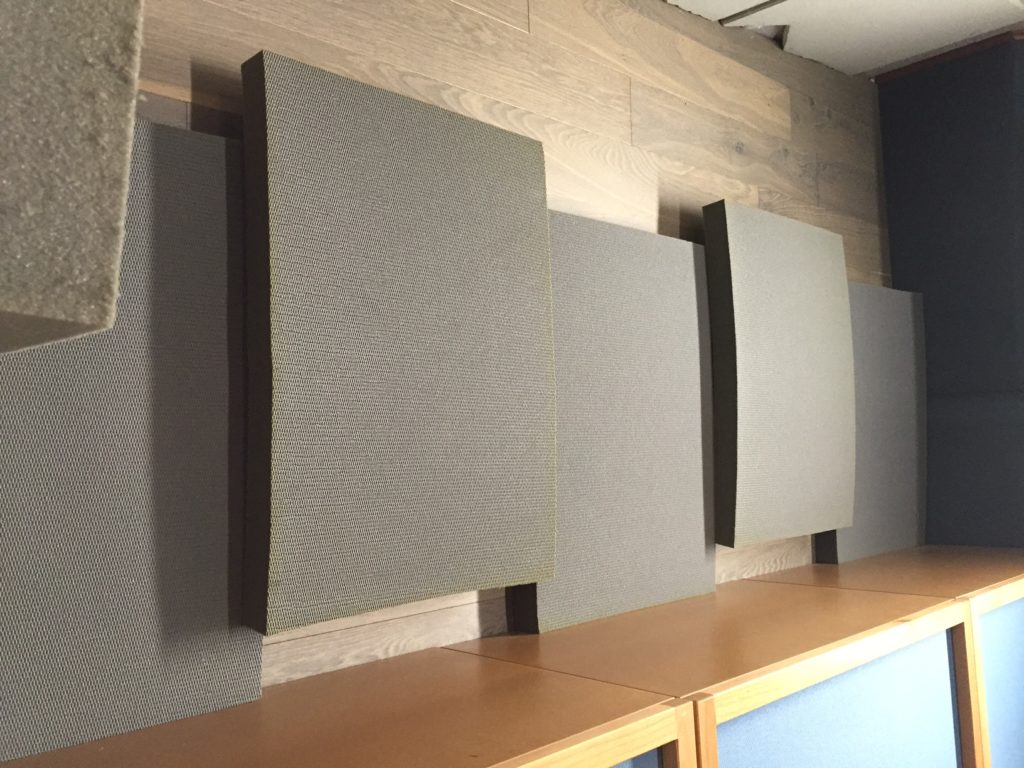
There are many types of sound absorption devices available that claim to be bass traps or low frequency absorbing devices. There is the standard box filled with building insulation.  Foam wedges are another popular unit that is claimed to absorb low frequencies. None of these units are really low frequency absorbing devices. John Storyk, the principle of Walters Stork Design Group,  did a test on all of these devices in 2006 and published his results in an AES paper. His conclusion was that of the eight units he tested, only one actually did work  as claimed. It was a membrane absorber with  the most dense  front panel or another term could be diaphragmatic absorber.

Diaphragmatic Absorber

Diaphragmatic Absorber Construction

Diaphragmatic Absorber Construction

A diaphragmatic absorber is a cabinet that has a front wall that moves or vibrates in sympathy with the amount of sound pressure that is exerted upon it. The cabinet is more rigid than the front wall and is designed this way on purpose. The depth of the cabinet and the density of the materials used are critical in determining the frequency of resonance of that cabinet. One can design a diaphragmatic absorber to absorb any low frequency issues within a room. Foam wedges and boxes filled with building insulation can not.

Cabinet Fill Material

Inside the cabinet, there is an internal cabinet fill,  usually some type of building insulation material. One can take the internal fill material and expand upon it to increase its efficiency. The internal cabinet fill material must absorb internal cabinet resonances and also contribute to the cabinet’s overall performance. It is by far the only low frequency absorber that has the horsepower to actually tackle the energy generated from low frequency wavelengths. Diaphragmatic absorption is used extensively by the top room designers when they are designing and building multi- million dollar rooms.

BDA – Broadband Diaphragmatic Absorber -DIY

The BDA unit that we are offering is unique in many ways. First, the cabinet design is a tested unit that has undergone vibrational testing in our facility. It is designed to be as inert as possible using only one layer of material. At 4.4 lbs./ sq. ft. it is a heavy unit but mass is necessary if you are going to attempt to stop low frequency energy. The front wall has also been calculated to work with the chosen cabinet density and comes in at 2.4 lbs. / sq. ft.

Perforated Absorber Cabinet Fill

The internal cabinet fill is not just material inserted into the cabinet. The internal fill material is actually another unit itself. It is called a perforated absorber and is designed to absorb at a frequency that will minimize internal cabinet resonances and then compliment the total cabinet design to achieve absorption down into the 40 cycle range. A perforated absorber is a separate unit that has a front wall that has perforations of a certain diameter and certain number to produce a unit that has a specific resonant frequency.

FB – Foam Box – DIY

Foam Boxes

Foam Boxes

The FB or foam box unit is a cabinet that is designed to hold any type of acoustic foam that one desires. There are numerous open celled acoustic foams that are available in the marketplace and our foam box is a unit that one can build that can be finished to match any decor. The fabric face and frame assembly is the same process that we have used in our production units and we have many units that are now over six years old and holding up well. If the fabric is damaged, the face frame can be removed and a new piece put into its place.

QRD-11 Quadratic Residue Diffusor – DIY

The QDR-11 is an actual quadratic diffusor based on prime number 11. Each well depth and width has been calculated to produce a diffusion frequency range from 300 Hz.- 3,ooo Hz. Quadratic diffusion has been time tested and proven throughout the years and is used extensively by professional studio designers. Quadratic diffusors can be used to produce two dimensions of sound diffusion. A vertically positioned quadratic diffusor will diffuse energy in a horizontal dimension. A horizontally positioned diffusor will distribute sound energy in a vertical array.

Low, Middle, High Sound Management

Quadratic Diffusors

Quadratic Diffusors

We need to have low, middle, and high frequency sound energy control in our home theater, listening rooms, and professional recording studios. To accomplish this, we need to use sound absorption and sound diffusion technologies. Unfortunately, room acoustic technologies that really work well are expensive and you need numerous units to meet your acoustic objectives. With DIY units that one can build themselves, the costs of treating your rooms can be minimized without sacrificing room sonic integrity.


How To Soundproof A Rehearsal Room

What Are We Rehearsing?

If we are going to answer the question on how to soundproof a rehearsal room, we must first define what we are rehearsing. Is it vocals or instruments? Is it one vocal or many. Is it a single instrument or a small band. We need to know the amount of energy that will be created within the rehearsal room to plan accordingly for the correct soundproof method to employ both to the inside and outside of our rehearsal room.

Sound Absorbing Panels

Sound Absorbing Panels

Energy Assumptions

Lets first make some assumptions. Lets take a small choir, say 10 vocals and an 8 piece band. Lets use these two as our sound generating sources. These two sources will become the benchmark, so we can illustrate how to soundproof a rehearsal room. They both produce energy in similar but different parts of the frequency spectrum.

Concrete Barrier Molds

Concrete Barrier Molds

Concrete Shell

Once we know how much energy we are going to produce in the room, we can design the shell or barrier that will keep the sound generated from within our room, inside where it belongs and the noise generated from outside our rooms, outside where it belongs. A good start is concrete which will provide the barrier protection we need. We should make ours walls 8″ thick and poured concrete into molds is preferable to block. Block is a good second choice if poured concrete is not an option.

STC – Sound Transmission Loss

Sound transmission loss is the ability of a structure to reduce sound transmission from one side of the wall to the other A 8″ poured concrete wall will provide a sound class rating of 56. This means that if we have a sound source on one side of the wall that measures 90 dB, it will be 34 dB on the other side because the concrete barrier will reduce the sound pressure level by its sound transmission rating.

Concrete Barrier Finished Edge

Concrete Barrier Finished Edge

Dual Wood Framed Walls

if block or poured concrete is not an option, one can use a wood frame structure or rather two wood framed structures. We construct a 2″ x 4″ wall and then another 2″ x 4″ wall. We leave an air space of 4″ – 6″ whatever our physical location will permit. We isolate each wall from each other with the air space and we mechanically decouple each wall from the existing structure. This dual wall structure will afford almost the same STC value as a poured concrete wall. The poured concrete wall has a STC rating of and the dual wall has a STC rating of.

Room Size Critical

Once we have chosen our barrier configuration, we must focus on the inside of our room. If our room has been “acoustically sized” then we can begin right away with the acoustical treatment. If no thought or consideration has been given to the rehearsal room’s size then we must address that issue before we go any further. If we are rehearsing a small band then we need the correct room volume to accommodate the band’s frequency range which is a larger requirement than a vocal rehearsal room.

Room Modes

Room modes or resonances build up inside a room that is not large enough to accommodate the complete frequency range that is produced by the rehearsing source. Resonances, especially those created by lower frequencies, have no place within our rehearsal room. A microphone or band member placed in one of these modes, may not be able to hear themselves and the microphone will not be able to record the correct information because the sound needed to be recorded will be smothered by the resonances. For a small band rehearsal room make sure you have at least 30′ in one direction of the room. For a vocal room, make sure you have at least 15′ in one direction. Always choose higher ceilings for both rehearsal room sources.

Sound Absorption

Acoustical room treatment for your rehearsal room can be absorption. Low frequency absorption must be used to manage low frequency modes. It can not be foam or panels filled with building insulation. One must use tuned low frequency absorbers that can handle the low frequency energy created within room locations. Middle and high frequency absorption can be used to tame rehearsal room reflections to manage reverberation times. Make sure you choose the correct rate and level of absorption that compliments your use.

Sound Diffusion

Diffusion can be an important tool in dealing with room boundary reflections. Diffusion can take the reflected energy from the wall surfaces and spread that energy out in a fan like array in two dimensions. This spreading out of energy allows for a smoother presentation of energy at the microphone position. Two dimensions of diffusion can be achieved within your rehearsal room by using quadratic diffusion.

Quadratic Diffusors

Quadratic Diffusors

Variable Acoustics

Variable acoustics have gained popularity. One can have absorption panels that can be absorption on one side and diffusion on the other. An engineer can alternate between absorption and diffusion to suit the recording engineer’s acoustical palette. Portable low frequency absorbers can be rolled in to handle room resonances at certain places within the rehearsal room.

Follow Steps

When you are planning on how to soundproof a rehearsal room, you must first define what sound producing sources are going to be using the room. Once determined, you can assign the correct barrier technology to manage the sound pressure levels generated from the rehearsing source and keep wanted sound within the room and unwanted sound outside. The rehearsal room must have the correct volume to accommodate each source whether from a single vocal, a choir, or a small band. Proper room volume minimizes room resonances. A combination of absorption and diffusion technologies can be used inside the room.

Electricity For And In Our Recording Studios

Grid Noise

We all know that the energy we receive from our local utility is full of noise. There is a whole industry out there of power conditioning companies who will for a fee provide you with a filter to take this noise or that noise out of the grid system for you. Gear companies will even provide you with gear that has its own power supply, so that their equipment does not have to use that noisy grid energy. Even power fluctuations can occur at different time periods during the day depending on the specific demand on the grid itself. Our studio usually runs at 121 volts during the day but in the evening it can go to 123 volts and even 125 volts after midnight.

Gear Stacks

Gear Stacks

Equipment Energy

Once we have the issue of producing clean energy for our studio resolved, we can deal with the noise produced by the electronic equipment that will reside within our studio. Each unit  in the signal chain has some type of electronic signature. Noise energy can be transmitted through the power wires of our studio to other units or even be distributed through the air. Remember, amplifiers do what they were designed to do, they amplify both pure signal and don’t forget about the pure noise.

Equipment Is Amplifier

The electric guitar is a good receiver/amplifier because of the way the electronics are made inside the guitar. The pick up of the guitar is a coil of copper wire which receives the signal and then sends it to an amplifier which is another device that has coils encasing a piece of iron to guess what, create an electromagnet. Thus, both the pick up and the amplifier share the same electrical DNA by acting like transformers which radiate and receive electrical fields. There are also pick ups that have two or more coils.

Humbuckers

Humbucker pick ups are known for their unique sound quailty. The famous Humbucking pickups have two coils that are wired out of phase with each other. Thus, the noise that is shared with the coils is in phase and eliminated from the system. This is a common electrical technique for dealing with noise within the lines of our electrical systems. Computers also share this same genetic code.

Noisy Computers

Laptop and desk computers also have coils within them. Look at any circuit board and one will find tiny cylinders of copper wound wire. Electrons are flowing through these coils to assist in the production of video images. Even the popular flat panel, LED and plasma, have coils inside of them. There is always a light source behind the panel screen that produces the color images. This process of providing the energy for the screen light and then the panel itself also produces noise. Watch how you run your cables together. Keep all power cables well away from video and audio signals. If they do have to cross, make sure they cross perpendicular to the audio and video cables.

Residential Dimmers

Residential Dimmers

Dimmers

Dimmers are a device that must be used with caution. Watch the quality level you use in your studio and do not use any dimmers that were made for your home. They produce too much noise because of the electrical process they use to “dim” your lights. These residential dimmers to not vary voltage to dim your lights. Instead they take a knife to our 60 cycle electrical wave and divide it into pieces. They use small pieces of the wave for dim light and all the wave not chopped up for the brighter light. Always use what is called a Variac dimmer. They do not generate the high frequency noise that will travel  through the air, but keep the transformers away from your gear just to be safe.

Cable Connector Mount

The way your cable connector is mounted to the gear chassis will also play a factor in how much resistance to noise the unit has. Our electrical goal is to create an electrical bypass so that the noise will exit the cable and flow into something else other than be transferred to our unit.  If  the noise gets into the unit, it is much harder to find and eliminate within the circuitry.  This is called the PIN-1 nomenclature used within the electronic literature.

XLR, RCA, Firewire, USB

XLR, RCA, Firewire, and USB are all connectors that can have issues with this dilemma.  The shield / pin-1 connector must be routed directly to the metal chassis. Some connectors are isolated from the gear chassis because it is easier to make in the manufacturing process. Manufactures run the signal path from pin-1 through a printed circuit to save space and money, but this process amplifies all the noise before sending it to ground. Keep the ground out of the circuitry.

Noise In / Noise Out

We must be conscious of the noise within the power that comes into our studio and then once inside, we must be careful with the noise that power can create within our gear. Computers, cable connectors, and even dimmer control devices must all be examined for noise producing capabilities. Watch for the transformer concept with pick ups and the ground connection on all our gear’s metal housing.

Sound Transmission Class (STC) Unraveled

STC Defined

STC or sound transmission class is a rating system used mostly in North America to measure or rather assign a number to the ability of a barrier or partition to inhibit sound energy from passing through it. Outside North America, they use a term called SRI or sound reduction index.  STC is an average of measurement numbers that use 16 different frequency bands that begin at 125 Hz. and go through 4,000 Hz. The numbers are then assigned their respective positions on a sound pressure level curve that is derived using a complex algorithm. This algorithm produces one number which we call the STC rating of the structure or barrier. Unfortunately, the nature of the frequency range covered does not tell the whole story.

How It Works

If we have a noise source that we are trying to isolate from entering our room, and we measure the noise source to be at 80dB, then we have to decide what dB level we want in our room. If we want a noise level within our rooms of 50dB, then we need a barrier that can reduce our pressure levels by 30dB and we would seek a barrier with an STC rating of at least 30. However, this number is frequency dependent. Our barrier may attenuate 30 dB at 3,000 cycles but only 15  dB at 125 cycles. STC is an accurate number when the sound energy we are trying to isolate from is spread out evenly across the frequency spectrum and does not go below 125 Hz.

Concrete Barrier Finished Edge

Concrete Barrier Finished Edge

Whole Story

If we are concerned with the human vocal range which is from 1oo Hz. – 800 Hz., one can see that an STC measurement has value, since the STC measurement frequency bands fall within that range. If we are trying to isolate human vocals in an office setting then an STC value of a considered barrier, will have some validity. However, if we are dealing with frequencies that fall below 125 cycles, such as large trucks and explosions in our home theaters, then we need to be more careful and consider how our barrier will react to frequencies below 125 cycles.

Old School

The STC rating system was developed back in 1961 and has not been updated since that time period. During that time period we did not have the lower frequency energy issues we have today with home theaters and more people. Computer processing was almost non existent and if it was processing power was low. STC ratings that were assigned during that time period are still used today even though the products they are assigned to from then are no where close in composition to their original form.  A good rule of thumb is to not trust ratings that were assigned before 2,000 because testing equipment was not that sophisticated and the margin of error could be as high as plus or minus 6dB. It is best to use STC in combination with other measurements.

Newer Rating Systems

The American Society For Testing Materials. The ASTM measurement system has three basic divisions: STC,  CAC, and OITC . The CAC is the ceiling attenuation class which is for ceiling structures. The OITC is for outdoor / indoor transmission class that measures the sound transmission between outdoor and indoor structures. OITC uses a noise source spectrum that takes into considerations frequencies down to 80 cycles which is far more useful in today’s world. The IIC or Impact Isolation Class is a number that tells us how well a floor attenuates sounds from footsteps and dropped objects. Similar to STC, the IIC is formulated using frequencies from 100 Hz. – 3,150 Hz. The same lower frequency limitations apply as with the STC number especially if the stereo system on the floor above is full range.

Barrier Fence / Wall

Barrier Fence / Wall

Noise Criteria

NC or noise criteria number is a popular index. NC is a measure of just the noise itself and not the ability of a structure to inhibit it. It operates beginning at 63 cycles and moves up through 8,000 cycles.  To arrive at the NC number, we look at one third bands for a given spectrum of noise. The noise spectrum is specified as having a NC rating that is the same as the lowest NC curve that is not exceeded by the noise spectrum.

STC – A Mixed Blessing

An STC number or rating has to be examined closely. If we choose 125 Hz. as our frequency for discussion and one barrier allows more energy to pass through than the other barrier, the former will achieve a higher STC rating. This occurs because remember from our prior discussion that 125 Hz. is the lowest frequency examined for an STC rating.  Any amount of energy that passes below our lowest measured value will produce a higher STC rating and manufacturers have abused this simple issue.

Do Your Research

Most manufactures have data that indicates how their products perform below 125 Hz. It is just that an STC rating has been around for so long that there is no other standard present. One needs to look through the numbers to find the actual performance and isolation value. If a manufacturer does not have the supporting data below 125 cycles, one should look to ones that do.

New Standard Needed

STC or sound transmission class rating is a system for rating a structure’s ability to stop or hinder the transmission of sound through it. It is an old system established back in 1961 and is overdue for a change. A new system should be developed that will address frequencies below 125 cycles and will also be able to address spikes in sound pressure levels across the frequency range determined. One thing is for certain, whatever system is devised needs to go lower and include more current information.