Mindless EQ Zombies – Joe Gilder Gets To The Point!

Check out this post from Joe Gilder of homestudiocorner.com for today’s daily audiophile roundup. He writes about how the average audio engineer can be a mindless zombie sometimes. They may find themselves tweaking and boosting the EQ without any real sense of what they’re adjusting. It begins by making small adjustments, which cause you to make even more small adjustments – until pretty soon everything sounds bad. As he point out once you learn what frequencies ranges should sounds like, the better you’ll be at EQ’ing tracks.

Nice work Joe. Read the full article here:
Mindless EQ Zombies

Acoustically Incompetent: The Need For Architects To Learn To Listen?

I want to share this post by John Mayberry of prosoundweb.com for my daily audiophile roundup about how Modern American architects have a tendency to design rooms without considering their acoustic properties before construction begins. Sounds within a room become harder for humans to understand as they bounce around a room. Many methods – including very affordable ones – have been devised to reduce this effect, yet there are still plenty of American venues with poor acoustics. Reasons for this oversight may include a lack of acoustic education in architectural schools and a narrow focus on lighting by the architect.

It’s something of an important issue for us naturally. A good read and well worth your attention:
Acoustically Incompetent: The Need For Architects To Learn To Listen?

New Home Theater Set Up Approach Using Diffusion

Home Theaters Today

Our home theaters are complicated set ups from an acoustical perspective. In a 5.1 system set up, we have 5 separate channels plus the .1 which stands for our low frequency effects or in more common nomenclature, our sub woofer channel. We have a left and right channel which we are all familiar with because most of us started with stereo systems. We also have a center channel added which produces the vocals and dialogue that are critical to our movie presentation. Lets don’t forget about the rear channels in our 5.1 system. They are there to provide us with ambient information that is present and occurring behind us just as in a real life.

More Channels

To add more realism to the home theater scenario, we are now introduced to 7.1 home theater presentations. This means that in addition to our rear channels present in a 5.1 system, we have added two side channels. The addition of our side channel speakers is an attempt at more real life representation of the audio that we hear in real life situations. Some will argue that the addition of two more channels is just an attempt by audio manufacturers to sell more speakers and add an additional two channels of amplification to home theater receivers. Lets take the high road and work from the premise that we are trying to duplicate real life acoustics and add to the sonic realism of our home theater presentations. We even have 7.2 systems which can add another sub woofer to the mix and generate more low frequency energy for bigger explosions and larger sounding car crashes. Future configurations can even include 10.2 sound with 10 channels of individual energy and two more channels for low frequency energy.

Real Life Acoustics

In a real life scenario, we have audio and video coming at us from every direction. We have video that we see using our 50mm lens in our head. Our eyes see many things that may or may not have audio signals attached to them. We have sounds coming at us from the sides and back of our heads. We have sounds that emanate from our normal horizontal viewing, such as an airplane flying overhead. Most of this energy is reflected energy that is bounced off of many surfaces before it reaches our ears. Some of it we pay attention to and some of it we do not. The audio energy we pay attention to usually is the audio that has the most amplitude or volume and is the more direct energy that travels the shortest distance from the source creating the energy to our ears. We listen to the direct energy but hear the rest. In our home theaters, we pay attention to the direct sound from our left, right, and center channels because that sound is coordinated with the video presentation directly in front of us. The sides and rear of our home theaters represent the ambient or non localized audio which is blended with the home theater front sound.

Current Installation Practices

How do we install all of these multiple mono sources that represent these side and rear channels, so that they acoustically represent real life? Most installations that we observe have the speakers mounted on the side and rear walls and pointing at the listening position. Granted some side and rear channels are configured differently with speakers pointing in different configurations such as is the case with dipoles, but for the most part, side and rear channel speakers are direct firing and are aimed at the listening positions. Is this really how we hear or listen in real life? Is our real life acoustic a blend of multiple mono sources firing at us from every direction, or is our acoustic a blend of direct energy and reflected energy reaching our listening position in varied dimensions.

If we have a video screen in front of us, we need to have the audio correspond with the video. If an actor is speaking on the screen, the vocals must appear to emanate from the screen and not behind us. If a car drives from the left side of our screen to the right side, the audio presentation must track with the video and move from left to right in sync with the video. The left, right, and center channels do a good job of moving the audio signal around to achieve the necessary realism that our ears and eyes demand. Does the same hold true for the rear and side channels? Does the current side and rear channel configurations really acoustically present real life sound experiences?

Side And Rear Channels

Since the side and rear channels are really about secondary or ambient information that is heard in combination and laced with the direct sound from our left, right, and center channels, we need to recreate this phenomenon acoustically. Current home theater speakers and their respective installation positions do not accomplish this. Since most of the information we receive from the sides and rear channels is secondary information when compared to the direct signals from the front of the theater speakers, we need to present this information in the same manner as real life sound sources present it to our ears. The signal from the sides and rear channels needs to be a non localized signal and presented in a manner that creates a field of energy that is spread out evenly across the rear and sides of our listening position. To achieve this, we can use a time tested and acoustically proven blend of two dimensions of quadratic diffusion.

No More Wall Mounts

This new set up does not involve mounting speakers of any configuration to any wall surface. Speakers that are wall mounted, never sound realistic. There are too many acoustic anomalies that go with wall mounted speakers. It is never a good idea to position a energy producing device next to a room boundary surface. The speaker should be allowed to free stand on its own and not have room boundary surfaces to deal with. Instead of mounting our speakers to the side and rear walls, lets mount two dimensions of quadratic diffusors on those walls. Lets mount vertical and horizontal diffusors on both our side and rear walls, so that any sound energy that enters our diffusors is spread out in both horizontal and vertical directions across the listening position in our home theaters. This two dimensions of sound is more in tune with what we hear in real life acoustics.

Freestanding Side and Rear Speakers

To make sure we have the necessary information entering our diffusors, we position our side and rear channel speakers with the speakers firing into the diffusors and not at the listening position. Our speakers are facing the diffusors with their backs to the listening position. This configuration allows for the side and rear channel information to be non localized since the speakers have their backs facing the listening position in our home theaters. It also allows for the side and rear channel information to be spread out evenly in time and phase across the listening position with the more realistic and life like two dimensions of sound diffusion.

More Space Please

Obviously, this configuration requires more physical space than current home theater set ups. Side and rear channel speakers must be placed on stands at ear level just like the left, right, and center channels and have at least 6′ of space between the front of the speakers and the diffusors. The back of each speaker must be at least 5′ from the listening position. This front and back distance is necessary to allow the diffused waveform from our diffusors to properly form at the listening position.

With this new home theater rear and side channel diffusor blend, we have a more realistic acoustic than current wall mounted scenarios which direct fire the information at the listening position. Side and rear channel information is non localized and does not compete with the direct energy from our left, right, and center channel information, just like real life acoustics. Side and rear wall information is blended and laced in the correct balance with the front channel information.

Current home theater side and rear channel speaker mounting configurations do not realistically duplicate real life acoustical information sources. By using diffusion and a freestanding side and rear speaker set up we can achieve a sonic presentation that is more real and lifelike.

Music Recording vs Music Playback Environments

Record vs. Playback

I am always amazed at the difference between the recording process used for music and the playback process environments that individuals use to enjoy this recorded music in. In the recording process, the engineer has to make sure that all instruments and vocals are heard in the mix and that nothing is smothered or buried under another vocal or instrument. Different microphones are used to record vocals and instruments and separate microphones are used to even record the sound of the room. The professional recording engineer has separate rooms that are used to record certain instruments and vocals. Unfortunately, when this recorded music is played back, it is played back and heard in less than ideal environments that do not meet the same standards that it was created in.

Car Audio

Many sonic advancements have been made in the realm of car audio. There are car audio amplifiers that today resemble the equipment we have in many professional recording studios. One can use different amplifiers to power the middle and high frequencies. There are separate amplifiers one can even use to power the bass speakers in our cars, so that no energy is lost in the transient response coverage when a bass note is played simultaneously with a guitar note and the energy from the amplifier needed to produce the bass note does not rob energy from the middle and high frequency vocals and instruments. Bi-amplification and even tri-amplification are popular amplification scenarios today in car audio.

Car Audio Components

There are also many improvements in other components in the car audio signal chain. Digital to analog convertors have also come a long way in their ability to convert detailed, digital signals from our compact discs into analog waves that our ears can hear through our speakers. One can even purchase separate digital to analog convertors that are not integrated into the receiver in the dash. These processors can even send the signal to multiple speaker arrays which are spread out and located in different positions inside our vehicles with the sonic goal of bringing a more lifelike presentation to our mobile music environments. Special care and attention has been given to the number of speakers and the speaker positions inside our vehicles by car manufacturers to try and portray the music in a realistic manner. Electronics “steer” the audio signal to try and produce a multitude of “room sounds”.

Glass Bowl Effects

Unfortunately, all of this technology can not hide the impact of the music inside of our “glass bowl”. Listening to music inside of our vehicles is like listening to music inside of a glass room. Reflections from our windshield and our windows produce a harsh glare that can destroy any musical presentation our mobile equipment is capable of producing. Sound takes on the characteristics of the surfaces that it strikes. If it strikes wood, it takes on the welcomed smooth and warm “sound” of the wood. If it strikes glass, it takes on the harsh and glaring characteristics of the glass. This phenomenon is especially apparent with high frequencies which can produce an ear piercing glare. All of this reflected glare conceals parts of the music. The engineer who created the recording never wanted this to be part of what one heard in his recordings.

Glass Treatments

We can minimize reflections from our windshields by placing absorptive material on the windshield itself; just kidding. We realize that we must be able to see out of our windshield, but we can treat the primary reflection from our speakers to the windshield with small amounts of acoustic foam that do not interfere with our vision. We can also treat the dash of our vehicles with acoustical foam to minimize reflections from the windshield to the drivers and passengers listening
position. Don’t forget to treat the deck area behind the backseat and rear window. If you do not have rear seat passengers, you can also treat the rear side windows by temporarily placing acoustic foam on those windows. Make sure you are not obscuring any lateral or side vision pathways. Low frequency absorbers can be added to tighten up our bass response. They can be added inside our trunks or even placed behind the rear seats in our sports utility vehicles.

Room Treatment

In our room playback systems, we can also do many things to enhance our musical presentations. We can position our stereo systems in our room in a manner that produces a frequency response that is smooth and even with no exaggeration or loss of any frequency groups. We can control side wall reflections at our listening positions by treating them with sound absorption or sound diffusion technologies. Front and rear wall reflections can be treated with sound diffusion technologies that can spread reflections our evenly without any loss in signal. Our ceilings can even be treated to make our ceilings acoustically disappear and make our rooms appear sonically larger. Bass absorption technologies are available to minimize resonances produced by low frequency energy and clean up any muddle or smearing excess bass energy can produce.

Lets meet our recorded music and recording engineers half way and play it back in environments that allow for equal representations or all recorded material. Recording engineers go through great efforts to make sure we hear all of the music the artists use to create their music. They even design separate rooms to record vocals and drums in so that all sounds are captured and represented in the music. We do not need to have separate rooms for our musical playback environments, but we do need to have environments that allow for all the music to be heard and hopefully felt. Lets make sure we listen to the music without hearing the room or the car.

Wednesday Mailbag – What’s The Best Way To Hang Up Acoustic Foam

Hi All,

Back with another Wednesday Mailbag. This week it’s from Glen in Buffalo asking:

Hi Mike,

I’m about to start work on a new studio space and want to get the Acoustic foam in place early. What’s the best way to mount and hang it to give the best results? The walls are cylinder blocks btw.

Thanks
Glen

————
Hi Glen,

Acoustic foams achieve their maximum absorption rates and levels by allowing air to be available to both sides of the foam. This is not an easy task, so you don’t see it done often in companies foam product line products. Remember, there are open celled and closed cell acoustic foams. Make sure you have selected the proper type with the necessary rates and levels of absorption to achieve the specific goals for your studio. Closed celled foams have a smoother absorption curve with less peaks and valleys. Always use closed cell foams for vocal and drum rooms.

Since your new studio space is going to be a blend of science and your art, you want your foam in a manner that will allow you to hang it up if you will for a awhile and then be able to move it around as time and acoustical knowledge increases about the inherit acoustical issues present in your new control room. You will learn more and hear more each day with different source material. The most inexpensive way is to mount the foam to a 1/4″ thick piece of hardboard and then install the hardboard on the wall or ceiling. Make the foam and the hardboard the same size, so you can more easily deal with the cosmetics when you finally decide where it will all go on a permanent basis.

You can build an individual box for the foam and install an acoustically transparent fabric across the face. You can attach it to the wall with a picture hanging wire. You can also expand on this idea and frame around a large surface area and stretch the fabric across the whole framed area. Whatever method you choose, make sure your fabric is acoustically transparent and you do not squish the foam.

Cheers,
Mike

————

If you have a burning question about your home theatre or studio sound then please feel free to mail in to info@acousticfields.com and I’ll answer at the next available opportunity.

Friday Mailbag – Should I Isolate My Amp With An Acoustic Foam Covered Box?

Hi Audiophile fans,

It’s time again for Friday mailbag. Today I’m answering an email I got from Scott in Detroit.

Hi Mike,

I’m operating in quite a tight home studio space and think I need to try to isolate my amp. The problem is that when I record using my mic into my amp it’s not far from my computer so when I play it makes my monitor meter spike. It seems to pick up a bit of fuzz on the playback so I’m wandering if a box covered in acoustic foam might be the answer. That way I can isolate it.

Would that work or is it going to cause more problems?

Regards
Scott

—————-

Hi Scott,

The energy that is coming from your amplifier is from two possible sources. You could be receiving fan noise from the cooling mechanism in your amp at the mike position or you could be receiving higher frequency energy transmitted from the electrical circuit systems in your amplifier. Amplifiers do just that, they amplify energy. Maybe that energy is being “transmitted” by your amplifier. RF noise can also be a factor. The fan noise can be dealt with using sound absorption technology. The electrical higher frequency energy being transmitted from your amplifier or into the amplifier must be contained by using barrier technology.

Measure the frequency range of the fan noise and find an open celled or closed cell foam product that will absorb the excess fan noise. You may be able to build a small cabinet lined with foam and place your amplifier in it. If the fan is at the rear of the amplifier you may just need to install the foam around the fan. Try to get the foam as close to the fan itself without interrupting the air flow created by the fan for amplifier cooling.

The higher frequency electrically generated energy from the amplifier or into the amplifier, must be restricted from emanating from the amplifier to other electrical components. To do this, we will have to place the amplifier in a box. Not just any box but one made out of aluminum. Aluminum is the metal that will provide the high frequency energy shield for your other components. If you have both “noise” issues you can use an aluminum box lined with foam. Make sure you do not restrict air flow to the amplifier in your cabinet design.

Regards,
Mike

—————-

If you have a burning question about your home theatre or studio sound then please feel free to mail in to info@acousticfields.com and I’ll answer at the next available opportunity.

The Differences Between Sound Proofing Materials Explained

Soundproofing Materials

Soundproofing materials use and proper selection are determined by how much noise level we are dealing with and where that noise level originates from. If the unwanted noise is originating from the outside of the room or structure we seek to soundproof, we need to use barrier soundproofing technology. We need to place a barrier between us and the noise we are trying to get away from. If our noise levels originate from within our room we are trying to soundproof, we will have to use absorption technology. On some occasions, we may have to use both barrier and sound absorption technology together to absorb excess energy within our room and to keep that energy from leaking into adjacent structures.

Building a Barrier

Barrier technology is just what the name implies. We construct a barrier between our room and the noise source. If we live on a busy street and the traffic interferes with our recording studio, we need to build a barrier between us and the car traffic. If we live in an apartment and we have a noisy neighbor, we need to build a barrier between our neighbor and our apartment. Barrier technology is not cheap to do and requires special construction techniques. One must choose what materials to use and how many. One must also decide what construction method we will use in assembling our barrier. Once we build our barrier, we then must install it within an existing structure. Care must be taken to mechanically decouple our new barrier wall or structure from the existing room. We must use vibrational control assembly and installation techniques.

Absorption Technology

Absorption technology is a different animal. Absorption technology really has nothing to do with mass except at low frequency absorption issues. Absorption technologies are usually light weight and easily positioned. The process of absorption is a physical one where sound energy is converted to heat. Once this conversion process has taken place, the sound energy is lost forever. It can not be changed back to sound once it has been changed to heat. There are numerous sound absorbing technologies available in the marketplace.

Barrier Materials

Barrier technologies are built with standard construction materials. Some materials used in barrier technologies include plywood, multiple density fiberboard, drywall, and even concrete and lead. Barrier technology materials are heavy and have high densities to minimize vibration. Vibration control becomes the design goal of a barrier. Air born sound energy strikes the barrier and is then converted to mechanical energy. This mechanical energy travels through the barrier we just constructed and these vibrations must be reduced in a systematic way to insure that they are reduced when they enter our room. It is difficult and very expensive to stop all noise issues. The best we can try and achieve is to lower the outside generated noise levels below a minimum acceptable level.

Must Reduce Vibrations

To minimize vibrational levels, we must construct our barrier in a vibrational reducing manner. The correct term for this construction methodology is termed constrained layer mass damping. We use different layers of materials that are constrained or combined together to achieve a mass that then serves as a vibrational damping unit. Each layer of our several material barrier must be assembled in a way that reduces vibrations. For example, if we are using plywood and drywall as two of our barrier materials, we must join these two materials together with another layer of material. In barrier technology creation the more materials used usually is for the better. We can join our plywood and drywall together using an acoustic glue that will provide the necessary adhesion benefits to keep the two materials together but not so together that the assembled unit acts as a single piece of material. Remember, our goal is to reduce vibrations by forcing them to go through different materials all with different densities. This process correctly done, can significantly reduce vibrations.
Absorption Materials

Absorption technologies can be common acoustical foams, draperies, numerous fabrics, and even furniture. Our acoustical goal with absorption technology is to provide enough of the chosen material, so that we can cover all the necessary surfaces of our room we wish to soundproof. A combination of sound absorbing materials usually works best. In most rooms where soundproofing within our room is the goal, we must cover all wall surfaces with sound absorption technologies and even add additional materials throughout the room to absorb lower frequencies than standard acoustic wall treatments can handle. A large stuffed chair can be used to absorb lower frequencies that our acoustical foam panels can not. If we want to scientifically attack our absorption issues and deal with them scientifically, we can use low frequency absorbers that are specifically designed to handle the low frequency energy issues specific to our individual room.

Sound proofing materials are problem specific. If we need to stop unwanted noise from outside our rooms, we need to build a barrier between ourselves and the noise source. We need to use materials that have high mass and densities. Barrier materials include plywood, drywall, concrete and even lead. Barrier materials have mass and density. If we need to absorb unwanted energy from within our room, we use absorption technologies. Absorption technologies include acoustical foams, draperies, and even a large chair.

How To Sound Proof A Door

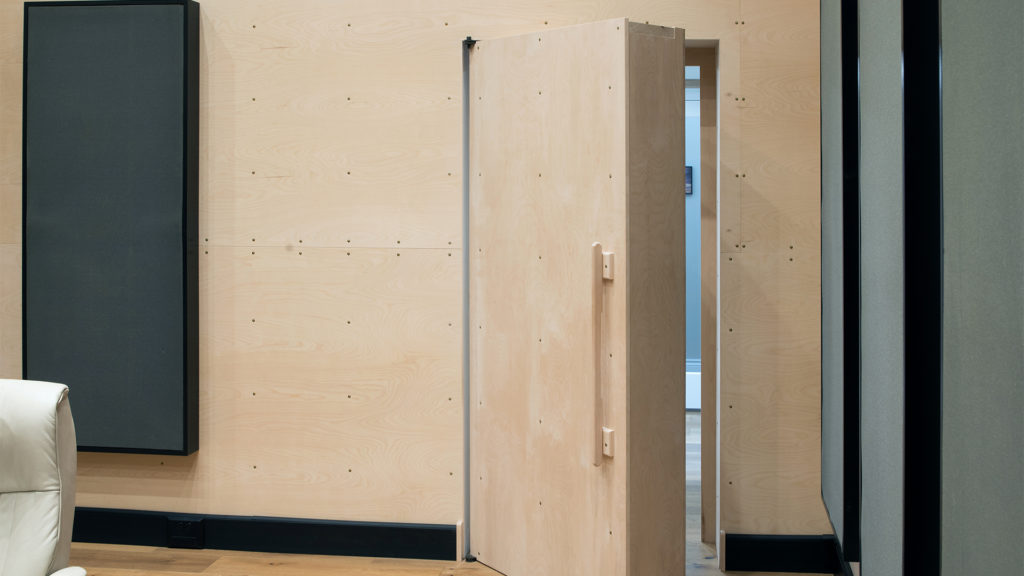
A door like a window can be a portal for noise or unwanted sound to enter our room. Acoustic doors have to perform a dual function. They must provide a barrier between the inside of the room and the outside noise levels. They also must keep sound energy generated from within the room from leaving the room and entering other adjacent rooms. They must do this on a temporary basis because they must open and close to allow for individual access into and out of the room. As they open and close continually, they must seal correctly, so that no gap exists between the door edges and especially the door bottom.

There Is s No Substitute For Mass

Our door through its use of barrier technology must have mass. Multiple layers of materials arranged in vibration reducing manners is the goal. Multiple density fiberboard (MDF) is a good material that provides us with the mass we need to begin our door construction. Remember from past discussions, that not only do we need mass in our material selection but we need to have different materials with different densities, so we can slow down vibrations coming through our door. Vibrations will lose energy if they have to struggle through different material types with different densities. If we use MDF, we can mate it with a plywood. Plywood has numerous layers that are fitted together into a single piece of material. Now we have two different materials that provide us with the appropriate densities.

Proper Assembly Required

We need to take our MDF and plywood and then assemble these two materials in a manner that reduces vibrations. Sound produces and is produced by vibrations. When electromechanical sound from our loudspeakers is produced and strikes our door surface, it is turned into vibrational energy. This mechanical vibrational energy sets the surface it strikes into motion. When it strikes our door, our door must be made in a manner that allows for this to occur, but reduces the vibrations through the way it is assembled. To reduce these vibrations, we use a process termed constrained layer mass damping to sandwich our chosen materials together.

Constrained Layer Mass Damping

Constrained layer mass damping is a process where we take different material types with different densities and arrange them in a manner that keeps vibration reduction in mind. We sandwich each material together with another material such as an acoustical glue. The more materials the vibration has to go through, the better for its reduction. With our MDF, plywood, and now glue, we have three materials that vibrations must go through. The more the better to a point.

MDF / Plywood

If we place MDF as the outside of our door surface, we then can add our plywood underneath the MDF. To secure the two materials together, we need to glue them together. We use an acoustic glue that will keep both materials together and provide another material type with a different density that our unwanted vibrations must go through. If we use MDF on the other side of the plywood we should use a MDF piece that is a thicker or not as thick piece as the front piece. Remember, we want to vary the density or mass of the piece and the thickness of the material to further “confuse” the vibration. We should have as our acoustic goal to have our finished door weigh at least 9/lbs./sq.ft. to provide the necessary noise stopping power.

How to Hinge

Once we have our door assembled with its associated weight, we will need to place it into the door frame. If it is an existing door frame, we must make sure it can support our new acoustic door’s weight and then seal correctly around all door edge surfaces. We may want to consider building a new door frame to support our new door. If we do not and choose to keep our existing frame, we must be sure it is sealed to the existing room structure with a healthy application of acoustic sealant.

To support our new heavy acoustic door, we will need hinges. A cam lift hinge will work well in this scenario. A cam lift hinge will assist us in proper sealing due to its construction method. A cam lift hinge can also support the weight of our new acoustic door. Numerous finishes are available on cam lift hinges to accommodate any decor.

Seal All Gaps

Finally, we must seal our new door to the door frame. All door edges must close squarely and seal properly. Special attention must be paid to the bottom of the door. This is an area where their is a lot of wear and tear and providing a continual seal every time is a must. We can use a brush type sealing strip that collapses when the door is opened or closed but then springs back into place to provide a good seal. There are numerous sealing strips available. Care must be taken to choose the correct stripping that matches the use of the door and the acoustical objective.

A door and window can be the weakest link in our room. We must use mass in our door to stop vibrations. We must assemble the materials in a manner that reduces vibrations and we must sure it seals correctly every time it opens and closes. It must be the correct mass and stiffness and be able to achieve a sound transmission class rating of at least 55.

Audiophile Monday Mailbag 23 April 2012

Hi All,

And welcome to my new weekly Monday mailbag where I’m going to answer the many questions that come in via email to us so as to help out fellow home studio designers and audiophiles. I’ll be here every Monday with answers to all your latest questions. So if you’ve got something you need answered in relation to sound diffussion, home studio and theatre sound design and more then please feel free to send them into info@acousticfields.com.

To get us started this week I thought I’d answer this message that came in from Todd in Atlanta, Georgia.

Hi Mike,

Been reading the blog for a while now and thought you were the perfect brain to pick before I get started with my studio installation. I really want to know what’s the best bang for my buck – acoustic foam or acoustic panels?

I’m almost done installing my vocal booth. I jusy need to finish the door and window plus I need to add the insulators but my funds are running out. Would I be better off getting foams or panels? In the long run what will be the difference in the sound recordings?

Thanks
Todd

Hi Todd,

It is nice to see someone taking on a vocal booth project. It is no easy task.

Window – Laminated Glass

Lets examine the window first. Always use a laminated window that has laminated glass on at least one side of your vocal booth window. A laminated window has a layer of plastic melted onto its surface and thus adhering to the glass pane itself. Remember, sound isolation technology is all about minimizing vibrations. Since you are on a budget, use 1/4″ thick laminated glass as a minimum thickness.

Position the glass into a frame and then secure the frame into the window opening. Use an acoustic sealant between the laminated glass and the window frame and also the vocal booth window opening and the frame itself. For better results, place another piece of laminated glass, 1/4″ thick, leaving a 1″ air space between both 1/4″ laminated pieces into the window frame. This dual pane method is worth the extra cost in materials, since it appears that you are doing all the labor.

Mass Layered Door

For the door, you can take two pieces of 1″ MDF or multiple density fiberboard. Make sure it is the commercial grade MDF, it will be smoother and easier to finish if you desire. on top of 1″ MDF door piece, glue a vibrational damping sheet of at least 1/8″ thickness to one of the MDF sides. Make sure there is more glue applied to the exposed damping compound. Place the second MDF piece on top of the glued damping compound. You must place an acoustic glue or sealant on both sides of the damping compound. You are making a sandwich of two – 1″ pieces of MDF with a thin slice of vibrational damping compound glued between them.

Place self tapping deck screws that are 1/1/2″ long, 12″ on center throughout the door surface area. This is a heavy door. make sure your hinges can support the weight. You will be at 10 lbs/sq.ft. Do not forget to include a heavy duty weatherstrip between all edges of the door to door frame contact ares. A small air hole is like a leak in a high pressure dam. It will leak lots of sound energy.

Inside Booth Foam

Treating the inside of your vocal booth with foam absorbing technology is the most economical way to cover the vocal frequency ranges you will be dealing with which start around 150 Hz. and go past 4,000 Hz. Make sure you choose a foam that absorbs at the proper rates and levels that are necessary for you to achieve whatever vocal sound you are going for. A closed cell foam will give you those necessary rates and levels of absorption in your vocal booth. Thicker closed cell foams will produce higher rates and levels than thinner foam of the same type. I would suggest starting with 1″ thick closed cell foam.

Regards,
Mike

How To Sound Proof Your Ceiling

Sound proofing our ceilings is probably the most difficult part of our room to deal with, simply because we have to support any material type we decide to use with our existing ceiling or by building a new structure. If we are dealing with a lot of noise from adjacent rooms, we will need to measure how large of a noise problem we actually have, so we can figure out exactly how much material we need to use. We definitely don’t want to use any more material than the noise issue demands since we have to support any material we will use with the existing structure or build a new one.

Measure The Problem

Our first task is to measure how much noise we have to deal with. If our noise is coming from our own room and we need to seal that noise from drifting into other rooms, we need to measure the noise from within our room and start with that issue first. If the noise is external to our room, we need to measure it and find how much of a noise issue we have to deal with. Remember from past discussions, that both noise sources whether external or internal require different forms of acoustic treatment. Barrier technology is used to keep noise from entering our room from external sources and also keeping our own noise levels generated in the room from “bleeding” into existing structures. If we need to control room boundary reflections and general small noise levels within our rooms, we can use absorption technology.

If our noise levels are determined to generate from external causes we will need to use barrier technologies to place a barrier between us and the noise. Once we have determined how much noise we have to isolate ourselves from and at what levels we are dealing with, we can choose the appropriate barrier materials and technology we need. All barrier materials have mass and weight associated with them. Barrier technology is all about controlling vibrations from sound pressure waves that are produced by our noise source. Mass and high density materials have to be arranged in a certain vibrational controlling method termed constrained layer mass damping. Multiple layers of materials with different densities are arranged in a manner that produces the least vibrational transfer of energy.

Build a Noise Barrier

To build a barrier for our ceiling, we will start with two commonly found construction materials. We can use plywood and drywall or gypsum board. We can start by taking our plywood piece with a 1/2″ thickness and then placing an “acoustical glue” between the plywood and the 3/8″ layer of drywall. Acoustic glue never hardens completely and the two materials that it is bonding with “float” against each other. This layering of materials technique is termed constrained layer mass damping.

In a constrained layer, mass damping configuration, all layers of high density materials must be separated or mechanically decoupled from each other to minimize vibrations from transferring from one piece of material to another. By isolating each higher density piece of material with a lower density or viseoelastic damping compound, the vibration must travel through all of these materials and as it does it losses energy and this is our goal. If we can reduce the vibrations strength, then we can minimize the sound or noise energy that vibrations can produce.

To further increase our barrier’s strength against vibrations, we can physically arrange the materials in ways that will reduce vibrations. If we are using multiple layers of plywood, we can arrange one piece of plywood one grain direction and position the other in a cross grain direction from our original piece. This running of the grains in different directions can go a long way to assist us in reducing our vibrational levels.

Installation Is Critical

Installing our new barrier technology requires care and careful consideration. We must install our new ceiling in a manner that continues our vibrational isolation theme. We must separate the new ceiling from the old or existing one using vibration isolation techniques. We first install a series of isolation tracks that our new ceiling will attach to. These tracks will physically decouple our new ceiling from the existing one and create an air space between the old and new ceiling. Air is also a vibration reducing material and can be effective as another layer for vibrations to have to work themselves through.

Watch Those Edges

We must pay particular attention to the edges of our new ceiling. In most ceilings, the ceiling edge surfaces touch the existing walls. There is no gap or space between the edge of the ceiling and the wall surfaces. While this looks nice in normal environments, it can be detrimental when dealing with vibrations that contribute to noise. Our new ceiling or barrier must have itself physically isolated from our existing room structure by leaving a gap between our new ceiling and existing wall structure. This physical gap serves two purposes. First, it isolates our new ceiling from the walls which will prevent the vibrations from our walls from entering our new ceiling barrier. Secondly, the small gap will prevent vibrations from our ceiling from entering into the walls and causing more issues. This small gap will be filled in with an acoustical sealant.

Absorption Inside Our Rooms

Noise levels in our room can be controlled through the use of absorption. We can absorb excess low, middle, and high frequency energy inside our rooms using many different types and forms of absorption technology. If we have noisy office equipment, we can place these units in sound isolating cabinets. HVAC noise can be controlled by lining our duct work with special foam technology that can reduce the air flow in the duct work itself. We can also reduce the fan noise by lowering the fan speed to reduce air flow. We need to lower the air flow down below 340 feet per minute.

Sound proofing your ceiling is not an easy task. If we have to build a barrier between our existing ceiling surfaces and outside noise levels, we really need a professional to design and install it. One can spend more money and energy making mistakes by guessing how much material to use and building and installing it incorrectly, than it would take to actually have a professional do it. Controlling noise levels within our room using absorption technologies can be a do it yourself project with adequate research done ahead of material selection and installation. `